AI Visibility for Local Business

Your next customer is asking AI who to use. Make sure you are on the list.

BlueWing rebuilds your digital presence so the AI assistants people now ask for recommendations can find you, describe you correctly, and put you on the short list — then keeps you there as the models change.

Tested on ChatGPT Gemini Perplexity Claude

The AI Snapshot free · The AI Correction from R3,500 once-off, then AI Visibility R4,000/month · 10 clients maximum

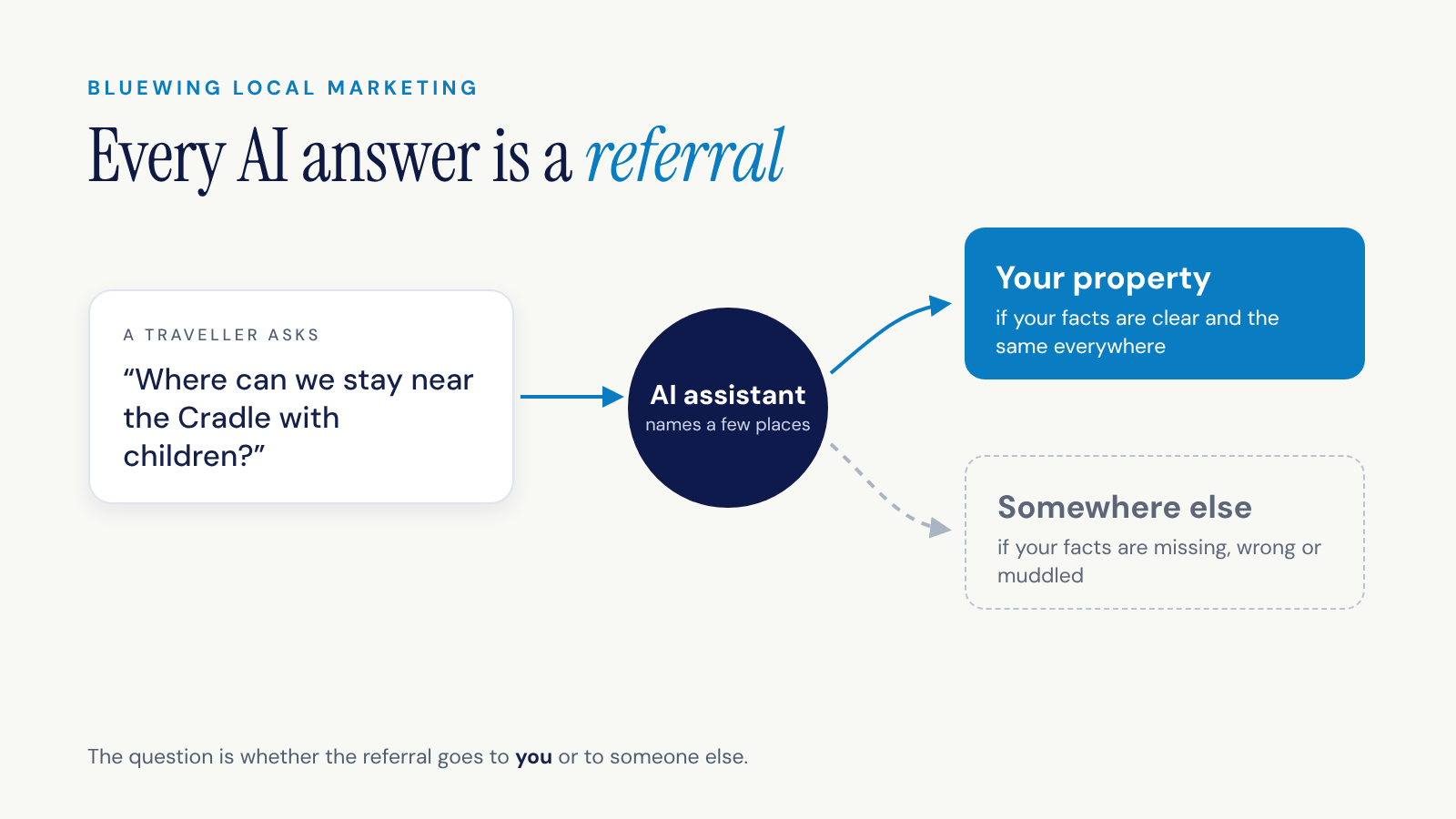
Illustrative — the test BlueWing runs, before and after the Correction.

Verified Google Reviews

A track record built before AI search existed.

27 five-star reviews from owners and managers Peter helped win real visibility results in Google Search and Google Business Profile — the same technical discipline that now extends to how AI tools like ChatGPT and Perplexity find and recommend a business.

"Three months after signing up with Peter, our diary was filled to capacity for the entire month of January. A colleague pointed out we had 16 new clients in just three days. When I asked them how they found us, an impressive number said Google — and some were referred by people who had also found us on Google. The compounding effect was remarkable."

"Peter has changed my business without buying a single adword. Of the 30-plus calls a day we now get, 28 come from Google. In hard Covid times we had more work than we knew what to do with. If you want to own prime spot on Google, Peter is your man — and I'm very happy to talk it through with you personally."

"Working with Peter Thompson is such a pleasure. He has a keen grasp of what works right now — Digital Marketing has changed, and he keeps up with those changes. The result for you as his next client is your business at the top of local search, with your website tied to sound fundamentals. Give him a call. You won't regret it."

These results are from Peter's Google Search and Google Business Profile work, delivered before his move into AI visibility. The underlying principle — technical accuracy AI systems can verify — is the same one BlueWing now applies to AI search.

The shift

Search has changed. Some businesses have already vanished from it.

When someone asks ChatGPT or Perplexity to recommend a specialist in Sandton, the AI doesn't run a traditional search. It draws on a model it has already built — and most local businesses simply don't exist in that model. Several BlueWing clients came to us after exactly this: businesses that ranked #1 on Google for years, then quietly stopped appearing at all once people started asking AI instead of searching.

Traditional search — still works, but shrinking

The old game

A person types a query. Google returns ten blue links. You compete for position 1–3. This still happens, but it's no longer the only game.

  • Keyword rankings are visible and measurable
  • Backlinks and page speed are the main levers
  • A good SEO score means you can be found
  • But: AI tools read your site differently from Google
AI-powered search — growing rapidly

The new game

A person asks an AI tool a question. The AI gives a confident answer naming specific businesses — a short list of a few it trusts, not ten equal links. The whole game is being on that list.

  • AI tools only name businesses they can verify
  • Verification needs consistent, checkable identity signals
  • A strong SEO score does not carry over to AI visibility
  • The gap between "found on Google" and "named by AI" is where we work

Illustrative. Not a list of ten equal links — a short list of three, ordered by proximity, reviews and verified expertise, each named with a reason. Being on that list is what BlueWing works on.

The programme · One foundation, then the work of holding it

One foundation. Then the work of holding it.

Every business starts with a free AI Snapshot that shows whether there is a real gap. If there is, the AI Correction builds the foundation — everything found and specified. It is sold in two parts, divided by whose hands the work needs: the part we can do ourselves, and the part that needs your developer. After that the position has to be held, because the AI models keep changing and your competitors are catching on.

0
Free
The AI SnapshotNo charge
Two parts, both free. Peter runs the test on your business himself, then sits down with you and goes through it.
Two readings, not one number. The first asks what a customer asks — for a business like yours, with your name left out — and records whether you are named at all. The second names you and checks what the assistant actually knows: what you do and where, the areas you serve, what you offer and what it costs, when you are open and how to reach you, who you are for, and what is said about you. Six facts, four assistants, twenty-four marks. Each one comes back correct, wrong or absent.
Why two. They behave differently, and averaging them into a single score hides both. Ask four assistants the same recommendation question twice and you will often get two different lists — that half moves on its own. What an assistant holds about you by name barely moves at all, so when that slips, something caused it. Wrong always outranks absent. A business nobody mentions is invisible; a business described wrongly is being misdescribed to somebody who was already looking for it.
The written Snapshot. Two pages, written for you rather than for a developer — the two readings above, which competitors are named instead of you, your website speed, how easily AI tools can read your site, your social profiles, and the state of your Google Business Profile. It is yours to keep either way.
A consultation with Peter. Thirty minutes on Google Meet, going through what the test found, what it means for your business, and what you could do about it — including the parts you could do yourself, at no cost.
Why the report is not simply emailed to you. A count on its own gets misread. Four facts wrong out of twenty-four can look alarming when the correction is an afternoon's work; a clean sheet can look comfortable while a competitor quietly takes the position. The figures only mean something once you know which finding is worth acting on and which can wait — so Peter goes through them with you first, and you keep the report afterwards either way.
Result: you will know exactly where you stand and what your single biggest gap is. If nothing significant turns up, Peter will tell you so and tell you to keep your money.
Continue only if the Snapshot shows a real gap
1
Correct
The AI CorrectionR3,500 + R2,400 once-off
Four layers, examined on every client. What gets changed is only what the examination turns up.
Two parts, split by who does the work. Off site, R3,500: layers 1 and 2 — deciding what the business is, and correcting your facts on Google, on your profiles and in the directories. Nobody touches your website and no developer is needed. On site, R2,400: layer 3 — the website items, written as instructions with a test attached and the wording supplied ready to use. This part begins only once somebody has agreed in writing to carry it out. Layer 4 re-tests whichever parts were bought. Both together, R5,900.
The reason for the split is simple. We will not charge you for work we cannot deliver ourselves. If your developer cannot or will not act, the off-site part still runs, and on most local businesses it is where the larger share of the problem sits.
1 Direction. (Off site.) Who you serve, what you want to be found for, and the questions your customers actually ask an AI tool. Between six and ten of them, settled in conversation with you and written up as a one-page Direction Statement you sign off before anything else is built. That set is then run in full, once, across all four assistants — the baseline everything afterwards is measured against. Every decision below follows from it.
2 Identity. (Off site.) Your Google Business Profile, the category you sit in, your reviews, and the same business details in every place a customer or an AI tool might check. This is the layer most often wrong, and the cheapest to put right.
3 Legibility. (On site.) Site speed, page structure, whether your site lets the AI tools in at all, and a written brief for your developer. That third one catches people out. AI companies send three different kinds of automated visitor: one that collects material to train the model, one that fetches your page at the moment a customer asks about you, and one that builds the index behind the answer. Turning the first away is a reasonable choice and costs you nothing. Turning away either of the other two takes you out of the answer completely, however good your page is — and it is almost always a security plugin or a past developer that did it, not you. Then the plainest rule we have, and the one most often broken by expensive websites: anything that matters has to be in the words on the page. Your hours, your prices, your service areas, your phone number — if they live only in the code behind the page, or inside an image, or in a downloadable document, they may as well not be there. Five of the major assistants were tested at reading a page directly and not one of them used the hidden markup. It is a common way for a business to be sure it has published something it has not. You also get the introduction file written from your Direction Statement rather than auto-generated by your platform, and a content list: which pages to fix, which to delete, which documents to turn into proper web pages, three starter topics, and plain writing rules for whoever writes your words.
4 Proof. (Whichever parts were bought.) Once it is installed, the same test is run again. You get the before and the after, in writing, on the same questions and against the same twenty-four facts — so a change in what the assistants hold about you is a counted change rather than an impression. We also open two measurement accounts in your own name and hand them to you. Microsoft and Google both now report how often a site is used in AI answers, so you can check the figures yourself rather than take ours. If we ever part company, they stay with you.
Result: a written record of every finding and every correction — the Correction Report, with a section for each pair of hands, plus the Owner's Guide setting out the monthly routine in plain language.
What the Correction covers
  • All four layers examined on every client, whichever parts you buy. Fixed prices for the whole engagement — no scope creep, no extras invoiced later.
  • The two parts are priced separately because they depend on different people, not because one is a lesser version of the other. Which parts can run is decided by your circumstances, not by your budget.
  • The Correction cannot come back empty — it is only recommended after your Snapshot has shown a real gap. If your Snapshot is clean, we tell you to keep your money.
  • Everything is written down and yours to keep. Any competent developer or copywriter can act on it. You do not need BlueWing to act on BlueWing's findings.
  • The foundation belongs to you permanently. No lock-in, no contract, no minimum term.
  • Where your website is missing something an AI tool needs to read, you get a written schedule of the pages that need to exist and what each must establish. Those words are yours to write — they are about your business, and we would only be guessing.
Month to month, from the day the foundation goes in  ·  One calendar month’s notice, no minimum term
2
Hold
AI VisibilityR4,000/month
AI Visibility holds a position. It cannot create one — that is what the Correction does. So the Correction always comes first.
After that, a foundation left alone goes stale. This keeps your position current as the AI models retrain and your competitors react — and keeps testing it, so you can see where you stand rather than hope. One level, not a ladder: there is no cheaper version that leaves out the part that matters.
Every month Google Business Profile posts. Review monitoring across every platform, with a reply drafted for each new one. Listing, social profile and consistency checks. A tracking reading — a named set of your own questions run across all four assistants — and your AI Visibility Report, titled with its month, saying plainly what moved and what did not. The routine that keeps the foundation from decaying
Every quarter The full reading: all six to ten of your questions, across all four assistants, marked against the same twenty-four facts as your first Snapshot. Your named competitor is put through the identical test, so what you get is a factual comparison — which of the six facts they hold that you do not — rather than a claim about who is winning. Plus a Direction review, because the questions your customers ask change as your business does. The reading that is properly comparable
Month to month. One calendar month's notice, no minimum term. A second business under the same owner is R3,000/month — not a discount, but a genuinely smaller job, because the relationship is already there even though the testing is not. Everything in the monthly routine is written out in your Owner's Guide — if you have the hour a month, and the discipline to find it again in month seven, you can run it yourself.

Why this does not finish

AI visibility is not a slab you pour once. It is a position inside a model that keeps being redrawn, and five things pull at it every month.

The models retrainWhat gets you named in July is not guaranteed in September. The systems are rebuilt regularly and nobody outside them is told when.
Competitors reactThe moment one business in your category gets named, the others start copying. Position is relative, and it is contested.
Freshness fadesA Google profile untouched for six months reads as a business that may have closed. Recency is a signal whether you use it or not.
Details driftA listing gets edited, a service is added, an address changes in one place and not another. The consistency you paid for slowly comes apart.
The standard movesWhat the AI tools expect to find keeps changing. Work that met the standard when it was built stops meeting it, without anything on your site having changed at all. Google has already begun rolling out booking agents in the United States that read a business’s live prices and availability, and in some trades will telephone the business on the customer’s behalf.

Why software cannot do this part

A tool can read your website and describe what is on it. It cannot decide who you serve, which work you want more of, or which competitors you need to be measured against. Those are judgments about your business, made by you and written down before anything is built.

That is why the first layer of the Correction is a conversation rather than a form — forty-five minutes, nothing to prepare, we ask and you answer — and why what gets built afterwards is specific to your business instead of the same thing everyone else gets.

What we do not promise
  • Nobody can promise that an AI tool will name your business. These systems are closed, they change without notice, and anyone who guarantees a position is guessing.
  • What we can do is make you the most legible business in your category, and keep you that way. That is what puts a business on the short list — and being on the list is the whole game.
  • You will always know where you stand, because the questions are re-run and the answer is written down — a tracking reading every month, the full set every quarter, and never an opinion where a count will do.
How BlueWing operates

Four rules. The same for everyone.

The programme above sets out what happens and when. These four rules govern how it is done — on every engagement, whatever the sector or the budget.

The rules that govern every engagement
1

Evidence first. Always.

The Correction is never sold cold. It is only recommended when your free Snapshot has shown a real gap — and if the Snapshot comes back clean, we tell you so and tell you to keep your money. A demonstrable problem is a precondition of the sale.

The Evidence Gate
2

Owner first. Always.

Every brief and every report is written in plain English for the business owner — not for the developer or the IT department. If the owner cannot read it and act on it, it is not finished.

The Owner-First Principle
3

Architect, not builder.

BlueWing specifies exactly what needs to be built and why. Your developer builds it. This keeps costs honest and prevents the conflict of interest that comes from selling both the advice and the work. Where a client has no developer, we can introduce one — the specifying and the building still stay in different hands.

The Architect Principle
4

Better, not guaranteed.

No one can promise that an AI tool will name your business, and we will not pretend otherwise. What we promise is a business AI tools can read, verify and describe correctly — measured against your own questions, re-tested on a stated schedule, and written down either way.

The Measurement Principle
Working with your developer

We work with the developer you already have.

We do not build websites, and we will not try to sell you a new one. Somebody else does the building — and in almost every case that somebody is the person who already looks after your site.

What we ask of them. A written list. Each item says what is wrong, exactly what to change, and the test that proves it worked. We then run that test ourselves and write down the result, with a date.

What we do not do. We do not charge your developer, take a share of their fee, or accept a referral fee from anybody.

None of this would stop us

What we do not mind at all

  • Their own website scoring badly on our tests.
  • Never having heard of any of this. Most have not.
  • Using a page builder rather than hand-written code.
  • Being one person rather than a firm.
  • Being your nephew, or somebody from your networking group.
  • Working from another city, or another country.
The six we cannot work around

These are different. They are not about skill, and no set of instructions can put them right. If one applies we will say so plainly, once, and explain what it means for the work.

1

They sell what we sell

Two suppliers doing one job. Sooner or later they disagree in front of you. That is a commercial interest, not a mistake.

2

You do not own the site

Rented websites, or sites that cannot be moved. We will not build value into something that is not yours to keep.

3

They will not be measured

One free test before, the same test after. Two minutes, no cost. Anyone unwilling to be measured is unwilling to be held to the result.

4

They guarantee a position

Nobody can promise first place by a stated date, because nobody controls it. One of us would be wrong in a way you had already paid for.

5

We cannot find out who they are

A registered business, a website of their own, two live sites we can look at. A low bar, and a business that cannot be found cannot be held to anything.

6

They quietly did something else

Work agreed and paid for, then replaced with something different and nobody told. We have seen four months pass before the owner noticed the enquiries had stopped.

If one of them applies

We do not walk away, and we do not ask you to dismiss anybody. That is your decision, not ours.

We carry on with everything that does not depend on your developer, and that is more than people expect: what your customers actually ask for, your Google listing, and settling what your business is called and where it says it is. None of that touches the website. We then tell you in writing which items are held up, and why.

That is also why the Correction is priced in two parts. You are never invoiced for website work that has nowhere to go.

The one thing we will not do

We will not do the building ourselves to get round the problem. What we do is worth something because we specify the work and then check it independently. The moment we are marking our own homework, you have no way of knowing whether any of it worked.

A standard, free to anyone who wants it. We publish the Site Readiness Standard: nineteen things a website has to satisfy before any of this can be measured, each with a test that you or your developer can run without us. There is no charge, nothing to sign, and no obligation of any kind. Most of the faults we find are on this list, and a developer who works to it saves their client our fee for finding them. Ask us for a copy and we will send it.

Who we work with

BlueWing works best for businesses people search for.

We work with a maximum of 10 active clients at any time. That is a real limit, not a sales line — it is one person doing the work, and the checking is done by hand. It keeps the work deep and Peter personally involved in every engagement.

You are a strong fit if

You depend on being found

  • Clients or patients find you through search — not purely referral
  • You serve Sandton, Johannesburg and the surrounding suburbs, or you are a specialist practice anywhere in South Africa
  • You are the decision-maker — no committee, no agency middleman
  • You control your own website and Google Business Profile, or you know who does — and your developer can complete a short technical list within ten working days, or you are willing to use one we introduce
  • You accept that a position has to be held, not just built once
  • You want to understand the work, not just pay for a black box
This is not the right fit if

Not our area

  • You rely entirely on referrals and have no interest in digital presence
  • You want social media management or Google Ads
  • You need a new website built from scratch
  • You cannot say who your business serves or what you want to be known for
  • You are not the decision-maker — an agency, spouse or committee must approve
  • You want results without understanding what is being done
What it is worth

The enquiry you lose is the one you never hear about.

When an AI assistant recommends a competitor instead of you, nothing arrives. No missed call, no bounced visit, no line in a report — the customer simply never reaches you. That is what makes this different from ordinary search, and it is why the honest measure is not a ranking: whether you are named, what they say about you, and who is named beside you. Nobody can sell you a position, because there is no fixed list to hold one on — ask the same recommendation question twice and the answer often differs. What can be measured, and what we write down, is how often you are reached at all and how much of what is said about you is correct. From the Correction onward you also hold Microsoft’s and Google’s own figures in your own name. What nobody can give you is a count of bookings won from AI — the assistants pass no visitor information through, and anyone offering you that number is guessing.

R0
Cost to start
Your free AI Snapshot costs nothing and commits you to nothing.
8
Sessions per test
In your free Snapshot: four assistants, two customer questions each, every session run separately so one answer cannot contaminate the next.
4/month
Assistants re-tested
A named set of your questions re-run every month on all four, and the full set every quarter, so you see movement instead of hoping for it.
Start here

Find out what AI says about your business.

No cost. No obligation. A written report showing where your business stands with the four main AI assistants — whether they reach you at all, and how much of what they say about you is correct — and half an hour with Peter to go through what it means.

Book your free AI Snapshot

Pick a time that suits you and answer three short questions when you book. Peter runs the test on your business before you speak, then walks you through what he found.

  • 01You choose a slot and tell us your business name, your website and the areas you serve. Under a minute. Your website address is needed at booking — the test is run before the call, not during it.
  • 02Peter runs the test on your business before you speak, so no time is spent watching him work. Please book at least two working days ahead; the test takes eight separate sessions to run properly.
  • 03Thirty minutes on Google Meet. The report is not emailed out beforehand — a count without its context gets misread. Peter takes you through it, and you keep it afterwards whether or not you do anything about it.
Book your free AI Snapshot →